
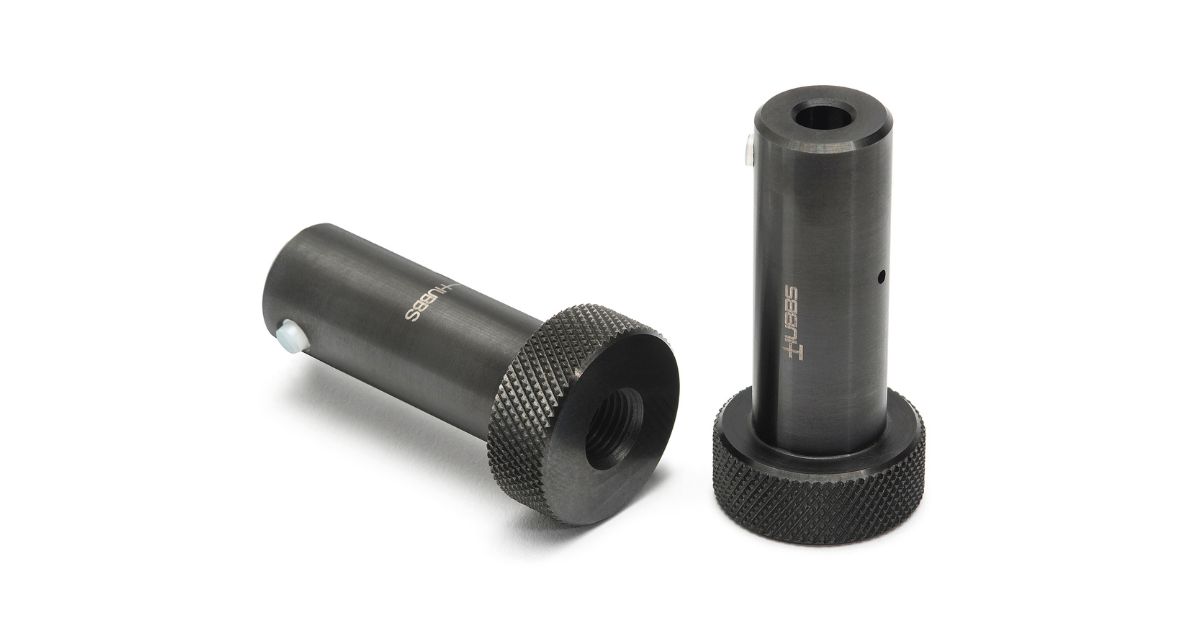
Innovation doesn’t just depend on bold ideas; it depends on the ability to measure them with certainty. From the first cut of raw material to the final inspection of a massive structure, precision tools transform complexity into confidence. The types of precision measuring tools you need are those that bridge imagination and execution, ensuring every detail aligns exactly as intended.
Whether handheld or high-tech, each instrument plays a role in keeping projects efficient, safe, and reliable. When accuracy becomes seamless, progress moves forward without hesitation. Building on that foundation, the next step is to examine advanced measurement solutions designed to handle the scale and complexity of today’s largest industrial projects.
At the core of modern industrial measurement are systems capable of capturing precise 3D data across vast spaces. These instruments serve as the foundation for alignment, inspection, and reverse engineering tasks.
Laser trackers serve as precision anchors for large-scale metrology. This device works by following a spherically mounted retroreflector (SMR) and calculating its three-dimensional position in real time.
This capability makes laser trackers ideal for aligning heavy machinery, verifying the geometry of large fixtures and jigs, and inspecting the form of aircraft fuselages or ship hulls. Their high accuracy over long distances provides a reliable reference for the most demanding applications.
When an application requires capturing millions of data points to define a complete surface, 3D laser scanners are the appropriate tool. These systems project a laser line or point across an object to create a dense “point cloud” representing its geometry.
The data the scanner collects is invaluable for reverse engineering parts. It performs surface-to-CAD comparisons and analyzes wear or deformation on critical components. Handheld and tripod-mounted versions offer flexibility for different environments and part sizes.
Photogrammetry uses high-resolution digital cameras to determine the 3D coordinates of points on an object. By taking multiple images from different angles, the system triangulates the position of strategically placed targets.
Photogrammetry excels at rapidly capturing the overall geometry of very large structures, such as a ship block or an entire aircraft wing. It is often used to establish a stable, high-accuracy reference network that other systems, like laser trackers, can use to maintain precision across an expansive work volume.
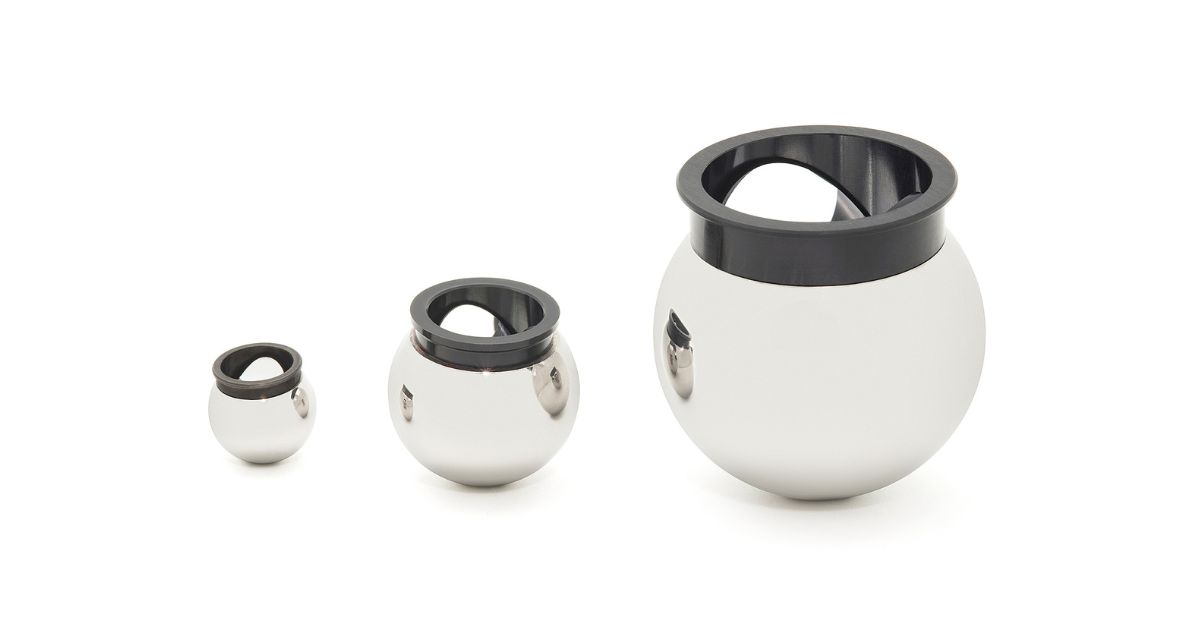
The accuracy of a metrology system is only as good as the accessories that support it. The targeting and mounting ecosystem consists of the specialized hardware that provides the physical interface between the measurement device and the part being inspected. This collection of 3D metrology tooling is what makes repeatable data collection possible.
Spherically Mounted Retroreflectors (SMRs) are precision optical targets used with laser trackers. The tracker’s laser beam enters the SMR, reflects off three mutually perpendicular internal faces, and returns directly along its original path.
This unique property allows the tracker to measure distance and angles with extreme precision. The quality of an SMR (defined by its sphere roundness and the centering of the optical element) directly affects measurement uncertainty.
To produce consistent results, SMRs must be placed in exactly the same position for repeated measurements. This is achieved with high-precision mounts, nests, and seats.
These components are machined to exacting tolerances and provide a stable kinematic interface for the SMR. Magnetic nests allow for quick placement on ferrous surfaces, while fixed nests can be permanently installed on jigs or fixtures to create a repeatable measurement routine.
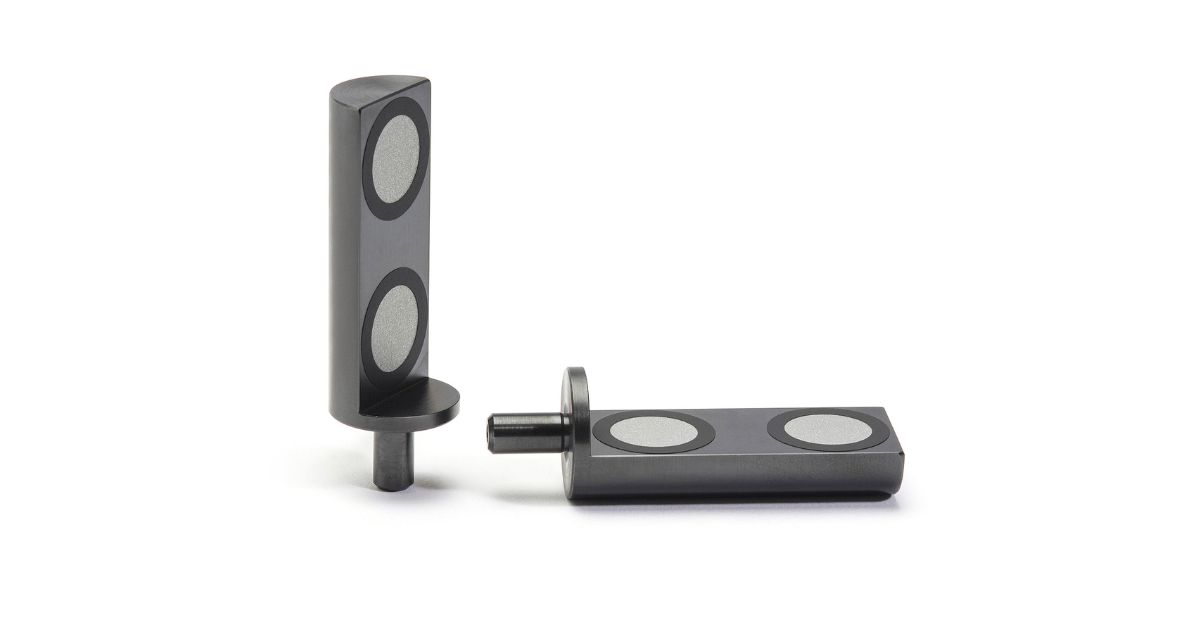
A versatile metrology toolkit requires a range of adapters and accessories. These accessories enhance the versatility of core instruments. They make it possible to measure challenging features and adjust targets to fit different configurations. Examples include thread adapters, target holders, and magnetic bases that add flexibility to any measurement job.
Just as laser trackers rely on SMRs, photogrammetry systems depend on their own set of targets and aids to function effectively.
These are typically high-contrast, retro-reflective dots or coded targets that the system’s software can automatically identify in images. Coded targets have unique patterns that help the software orient multiple photos, while non-coded targets increase the density of measurable points.
Proper application of these targets is crucial for building a robust geometric model. Contrast tapes and paints can also be used to improve the system’s ability to “see” features on reflective or dark surfaces.
Hardware is only half of the equation. Modern metrology software is the brain of the operation, translating raw measurement data into actionable insights. This software allows operators to align data to a CAD model, analyze Geometric Dimensioning and Tolerancing (GD&T) callouts, and generate clear deviation reports. Interoperability is key, as the software must seamlessly import native CAD formats and export data that integrates with existing quality management systems.
Different industries leverage these tools to solve unique measurement challenges.
For decades, HUBBS has set the benchmark for precision measurement products. Our expertly engineered tooling ranges from laser tracker sphere mounts to photogrammetry targets and specialized adapters. Our product catalog reflects a deep commitment to quality, repeatability, and long-term reliability.
HUBBS supports customers worldwide with ISO 9001:2015-certified solutions designed for demanding applications. Ready to advance your measurement capabilities? Explore our comprehensive product line or connect with the HUBBS team for tailored support and consultation.
One instrument does not suffice when building a capable metrology process. It requires a thoughtful selection of systems, accessories, and software that work together to deliver reliable data. By understanding the available types of precision measuring tools your organization needs, you can create a measurement strategy that upholds the highest standards of quality and performance.